Migrating production infrastructure? Get up to $10K in migration credits.
Apply nowAdded two Key Value plans and lowered prices for larger existing plans
Render now supports two additional compute plans for Key Value instances:
- 3 GB RAM with up to 3,000 simultaneous connections
- 50 GB RAM with up to 50,000 simultaneous connections
We've also reduced pricing for existing Key Value compute plans that provide at least 1 GB RAM. The reduced pricing takes effect for all applicable Key Value instances starting October 1.
View all available plans and their latest pricing on the pricing page. Learn more about Render Key Value in the docs.
Added Blueprint support for Render Workflows
You can now manage your workflow services using Blueprints, Render's infrastructure-as-code model.
Define workflows alongside other service types in your Blueprint YAML. Here's an example:
Workflows support most of the same configuration fields as other service types, with exceptions noted in the Blueprint YAML Reference. Notably, you don't provide a plan field for workflows, because you instead specify compute plans per task directly in your code.
Note the following:
- Workflows do not yet support preview environments, which skip replicating any workflows present in your Blueprint (other services are replicated as usual).
- Render rejects a Blueprint that would create a workflow with the same name as an existing Blueprint-managed workflow in your workspace.
Learn more about Render Workflows in the documentation.
See your service's deploys on a new page
Services now have a new Deploys page in the Render Dashboard.
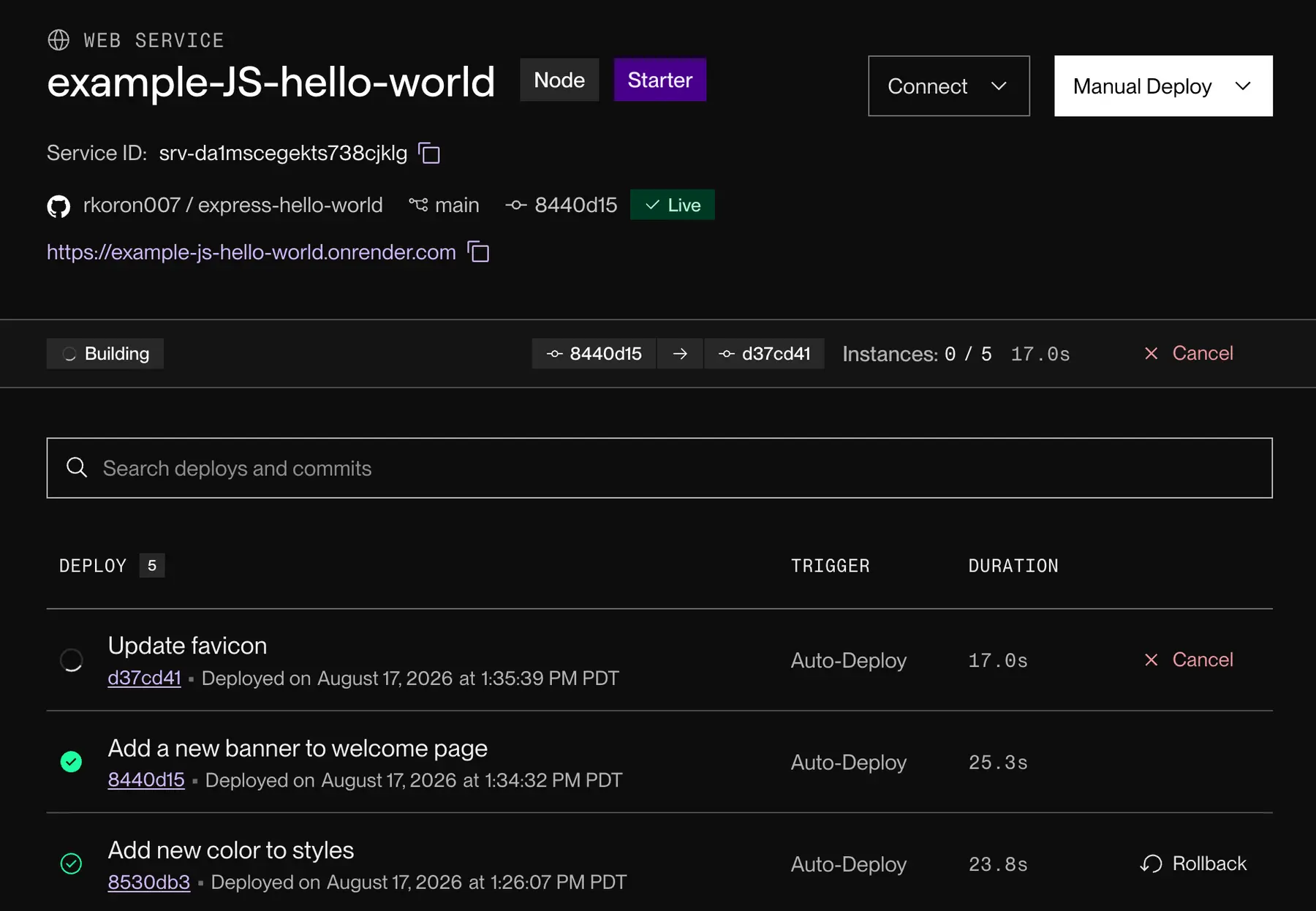
The Deploys page features:
- Your service's deploy history, without a date cutoff.
- A Live badge indicating the current deploy.
- Status of in-progress deploys.
- A banner flagging when auto-deploys are disabled.
Previously, deploys were only visible on the Events page, interspersed with other events, and capped at a 90-day history. The Events page continues to show all service events, including deploys.
Cron jobs also have new Builds and Runs pages that separate build and run history.
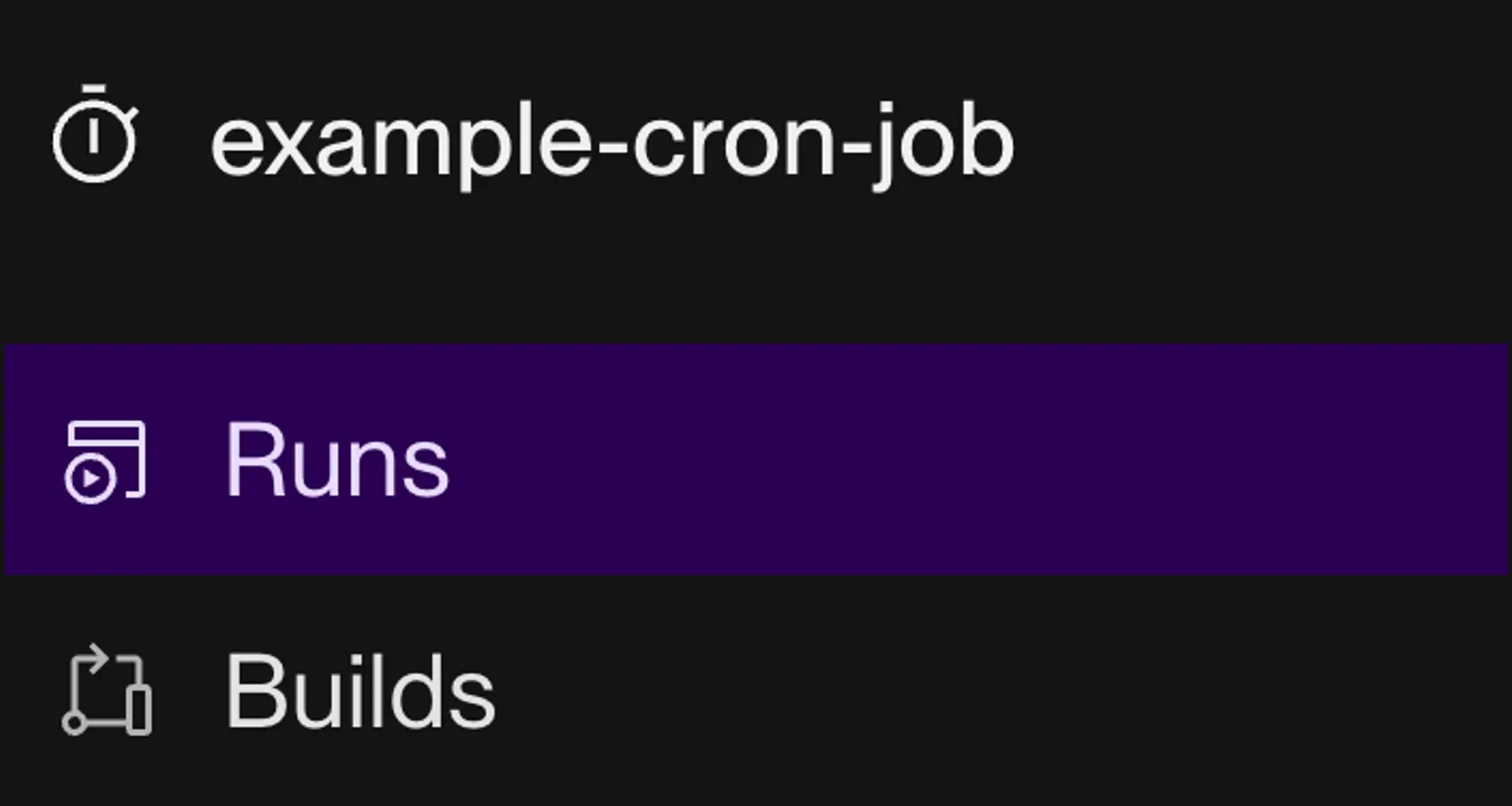
Learn more in the documentation.
Introduced the Flex compute plan for Render Workflows
Render Workflows uses a new default compute plan for task runs: flex.
The flex compute plan provides up to 1 CPU and 4 GB of RAM. Task runs on flex are billed only for the CPU and RAM they actually use, resulting in significantly lower costs for computationally inexpensive runs.
The flex compute plan replaces the starter and standard compute plans for Render Workflows. Tasks that previously used starter or standard now automatically use flex instead.
For tasks with higher resource requirements, you can assign a different compute plan in your task's definition:
Learn more about compute plans for Render Workflows in the documentation.
Added usage telemetry to the Render CLI
The Render CLI now automatically collects usage telemetry to help us understand common use cases and improve user experience. Telemetry is enabled by default in version 2.26.0 or later.
Telemetry includes the following:
- Commands run (e.g.,
render services list) - Command performance and completion status
- CLI version
- System information
- Execution context
The Render CLI does not collect sensitive user data, such as command arguments, environment variable values, passwords, or the contents of your files.
You can disable telemetry at any time by setting either the RENDER_CLI_DISABLE_ANALYTICS or DO_NOT_TRACK environment variables. For example:
Learn more in the documentation.
New compute plans, and new IDs for existing plans
We're introducing new compute plans for Render services, including memory-optimized plans with higher ratios of RAM to CPU and a new 12-CPU tier for web services, private services, and background workers.
To support the expanded catalog, we're also changing compute plan IDs to a spec-based format that includes the relevant specs. For example a web service compute plan with 4 CPU and 32GB RAM now carries the ID 4c-32g. This convention allows you to more easily intuit the specs of compute plans as we add additional options.
No action is needed to continue using your current compute plan(s). While you will see the IDs for plans change in the Render Dashboard and documentation, you can continue to use old plan IDs with the Render API, SDK, CLI, and Blueprints. To avoid any issues when you start using the new plan IDs, we recommend updating to the latest versions of Render clients and integrations, including the CLI and Terraform provider.
You can see the mapping of old plan names to new plan IDs in the Render Dashboard.
What’s new:
- Increase memory without increasing CPU. At each 2+ CPU tier (2 CPU, 4 CPU, 8 CPU, etc.) we are adding multiple plans with more RAM. For example, at 2 CPU you can now choose between web service plans with 4 GB, 8GB, and 16 GB RAM.
- 12-CPU plans for heavy workloads. For customers running agent platforms or other heavy workloads, we are adding a set of 12-CPU plans with up to 96GB RAM.
- New compute plan IDs. To keep plan IDs intuitive as we add more options, we are replacing legacy IDs (Pro Plus, Pro Ultra, etc) with simple spec-based IDs. For example, the 2 CPU 4 GB web service plan now has an ID of
2c-4g. The Render API, CLI, SDK, and Blueprints will remain backward compatible with legacy plan IDs. No action is required. - "Compute plan" replaces "instance type" across the dashboard, API, CLI, and docs.
Reduced median service build time by 40% (all runtimes)
Render service builds now run on nodes with faster CPU and disk. These improvements have reduced the median build time for a Render service by 40%, with this reduction reflected across all runtimes:
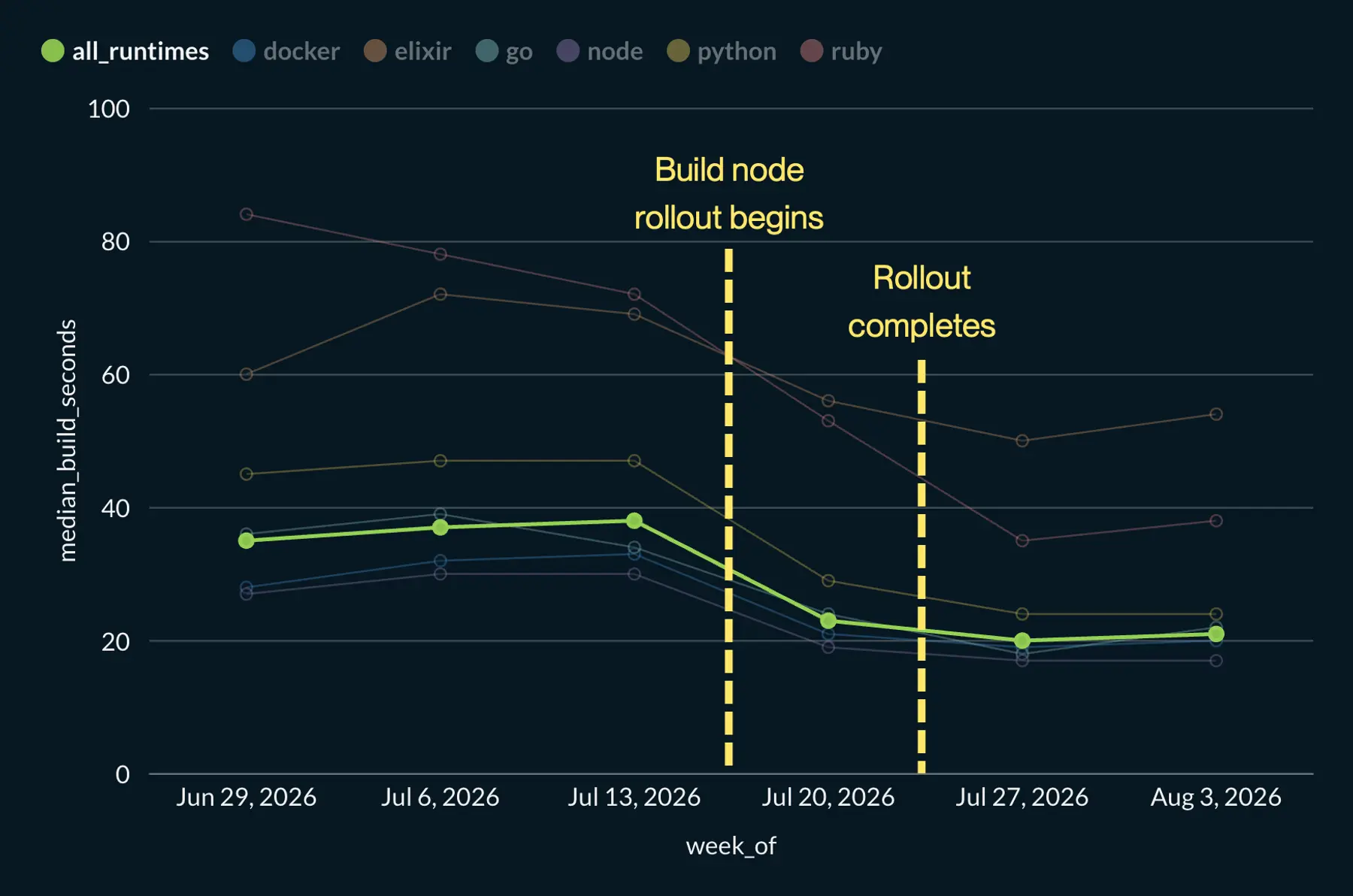
Before this rollout (week of July 13), median build time was 38 seconds, consistent with prior weeks. Since July 27 (the first full week post-rollout), the highest observed weekly median is 21 seconds, a conservative 40% reduction. Build times remain in this range.
This global build improvement follows recent single-runtime improvements for Node.js, Python, and Docker.
Managed OIDC now supports Anthropic and OpenAI
Render’s managed OpenID Connect (OIDC) authentication now supports Anthropic and OpenAI in addition to AWS.
Render services can authenticate to both providers without storing long-lived API keys. Render instead issues short-lived identity tokens for each service and automatically rotates them as needed.
To configure either provider, connect Render as an identity provider, map the appropriate service account, and add the required environment variables to your Render service. After you redeploy, Render automatically makes the service’s OIDC token available at runtime.
Managed OIDC requires a Pro workspace or higher. Get started in the documentation.
Render MCP now supports OAuth for Claude Code, Codex, and Cursor
The Render MCP server now supports OAuth-based authentication for Claude Code, Codex, and Cursor:

The MCP server continues to support API key authentication for other applications and non-interactive environments, such as CI/CD.
See setup instructions for each supported tool in the documentation.
Trigger service deploys with the Render MCP server
The Render MCP server now includes a trigger_deploy tool that enables you (and your agents) to kick off a new deploy of an existing service. This can be helpful for retrying a deploy after a transient failure or forcing a clean rebuild by clearing the build cache.
Get started with the Render MCP server and learn about all of its capabilities in the documentation.